


Your brand doesn’t fall apart overnight. It drifts.
One slightly off social post. A landing page that feels different from your ads. A new designer who interprets things their own way. Individually, none of it feels like a problem. Together, it starts to erode trust.
That’s where a brand book steps in. Not as a design deliverable, but as the system that keeps everything aligned when your business starts moving faster than your decisions can keep up.
We’ve seen this play out across websites, packaging, and campaigns at scale. At White Rabbit — a full-service agency built to keep brands from spiraling into chaos — we don’t just design things that look good in isolation. We build systems that hold together everywhere. If your brand feels like it’s hopping in five different directions, this is where you bring it back into the burrow.

What is a brand book (and how it differs from brand guidelines)
The real definition of a brand book
A brand book is a structured system that defines how your brand is applied, not just how it looks.
It controls how your identity shows up across your website, ads, packaging, social content, and anything else your audience touches. It removes interpretation. It replaces “I think this works” with “this is how it’s done.”
Most businesses don’t have this. They have fragments. A logo file. A couple of colors. Maybe a font choice that changes depending on who’s designing that day. That’s not a brand system. That’s a loose collection of decisions.
A proper brand book turns those decisions into rules.
Where brand guidelines fall short
Basic guidelines — or a branding book in its lighter form — give direction. A full brand book creates consistency at scale.
The difference is practical. Guidelines might tell you what your brand should look like. A brand book shows you exactly how to execute it across real scenarios, without second-guessing.
That distinction matters the moment more than one person is working on your brand.
Why most businesses get this wrong
Most companies stop too early. They invest in visuals, but not in structure.
At first, everything looks fine. Then the business grows. More people get involved. More content gets produced. And suddenly:
- The website doesn’t match the ads
- Social content feels disconnected
- Packaging looks like it belongs to a different brand
That inconsistency doesn’t come from bad design. It comes from a lack of system. Without a brand book, every new touchpoint becomes a chance for the brand to drift further off course.

What should a brand book include to actually work
Core visual rules that prevent drift
A strong brand book doesn’t try to impress. It tries to remove friction.
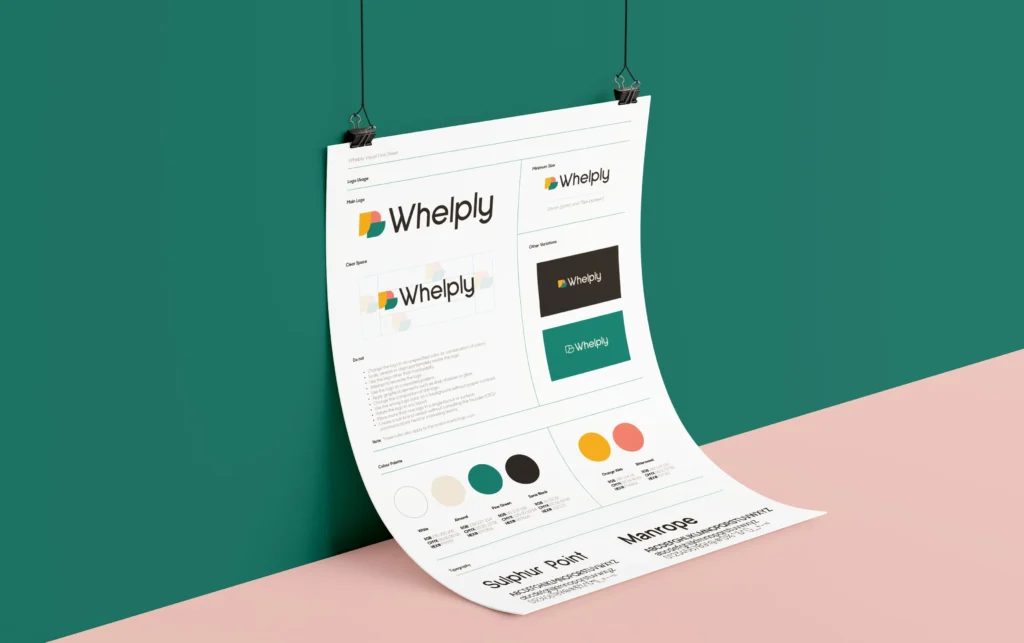
It defines how your logo behaves in the real world — spacing, scaling, and what not to do — so it doesn’t slowly degrade over time. It locks in your color system and typography with precision, ensuring that your brand doesn’t subtly shift depending on the platform or designer.
Messaging and voice consistency
Where most businesses underestimate things is messaging.
Your brand doesn’t just show up visually. It speaks. If your tone changes from page to page, it creates friction for the reader. A good brand book eliminates that by defining voice, tone, and messaging with clear examples.
Visual direction across every touchpoint
Then there’s visual direction. Photography, layout, illustration — the stuff that makes a brand feel cohesive without people being able to explain why.
Without this, brands end up looking like a Pinterest board with commitment issues.
The goal isn’t to create rules for the sake of control. It’s to create clarity so execution becomes faster, easier, and more consistent across everything you produce.
Why a brand book changes everything for your business
The trust and recognition effect
Consistency is what makes brands feel established.
When everything aligns — your site, your ads, your packaging — people stop questioning your credibility. They don’t notice the consistency directly, but they feel it. And that feeling translates into trust.
That trust compounds over time. It improves recognition. It shortens the gap between someone discovering your brand and actually choosing it.
Operational speed and efficiency
Operationally, the impact is just as significant.
Without a brand book, every project involves unnecessary decisions. With one, those decisions are already made. Designers move faster. Revisions drop. Teams stay aligned.
Scaling without chaos
This becomes critical as soon as you scale.
The moment you bring in new team members, freelancers, or agencies, your brand is no longer controlled by one person. It becomes a shared responsibility. Without a system, it fractures. With a brand book, it stays intact.
Brand book examples that show the difference
What strong brand book examples get right
Good brand book examples are not abstract. They are practical.
They show exactly how the brand is used across real scenarios. They include clear do’s and don’ts. They remove ambiguity. Anyone should be able to pick one up and apply the brand correctly without needing a walkthrough.
Where most brand books fall apart
Weak ones do the opposite. They stay high-level. They rely on vague language. They look polished, but they don’t guide real decisions.
How to evaluate a brand book properly
If you’re evaluating a brand book template or a custom solution, the test is simple: can someone unfamiliar with your brand use it correctly within minutes? If not, it’s not doing its job.
How to create a brand book that scales with your business
Build for growth, not just today
A brand book should be built with growth in mind.
That means it can’t just reflect where your business is today. It needs to account for how your brand will be used across new platforms, new campaigns, and new formats.
Keep it usable for everyone
The strongest brand books are simple enough to be used by anyone, but structured enough to maintain consistency across complex outputs.
Clarity always beats complexity.
Connect digital and physical branding
Your brand needs to translate across everything.
From your website design to your packaging design and even printed materials like brochure design, a strong brand book ensures everything feels cohesive.
Why most brand books fail (and how to avoid it)
They prioritize aesthetics over function
Most brand books fail because they try to look good instead of work well.
They’re too vague to guide decisions. They’re not built around real-world use cases. Or they’re disconnected from the actual goals of the business.
They ignore real-world execution
Many branding books look great in a presentation, then fall apart in execution.
If it doesn’t work in real scenarios, it doesn’t work.
They aren’t tied to business strategy
When branding isn’t aligned with positioning, audience, and growth strategy, it becomes decorative.
A brand book should support how your business grows, not just how it looks.
How our full-service approach builds brand books that actually work
One system, not multiple suppliers
This is where most businesses hit a wall.
They try to piece things together across multiple vendors. Different styles. Different interpretations. No cohesion.
With a full-service team, everything connects.
Specialists across every discipline
At White Rabbit, that means access to senior designers across everything — from logo design to digital, print, and beyond — all working within the same system.
No conflicting directions. No brand drift.
A process built for scalability
Our process is built around clarity and scalability.
We’re not handing over a static document. We’re building a system that holds up as your business grows. You can explore our work to see how that consistency shows up across real brands.

Get a brand book that transforms your business today
If your brand feels inconsistent, it’s not a design issue. It’s a structure issue. A strong brand book fixes that and gives your business something it can actually build on.
If you’re ready to stop guessing and start scaling with clarity, contact us and we’ll help you build a brand that doesn’t fall apart the moment it grows.