


Blink, and the evolution of logos has already leapt another decade forward. From stone carvings to slick vector files, logos have transformed from marks of ownership to emblems of identity, strategy, and style. Every curve, font, and color tells a story about who a brand is — and how it wants to be remembered.
In business, first impressions aren’t just important — they’re permanent. A logo appears everywhere: websites, business cards, product packaging, even on your client’s phone screen before you say hello. And yet, many brands underestimate how much their logo evolution reveals about their growth, values, and adaptability.
At White Rabbit, we know a logo isn’t just decoration. It’s strategy, psychology, and design all rolled into one pixel-perfect symbol. Our burrow of senior designers (and very caffeinated bunnies) builds brand identities that help companies stand out and hop ahead of the competition. If your current branding feels a little dusty, this is your cue to follow the white rabbit — and start evolving.

From ancient symbols to modern marks: the early evolution of a logo
The evolution of a logo started long before Photoshop or Pantone. Thousands of years ago, artisans and merchants used symbols to mark their work — a primitive form of branding that told others, “This is mine.” Egyptian masons etched hieroglyphs into stone, Roman potters stamped seals into clay, and medieval blacksmiths forged unique emblems onto their steelwork.
These early marks were the original trust signals. They told buyers who made a product and where it came from — not unlike how a logo on packaging today conveys authenticity and quality. Even without a single word, the message was clear: identity matters.
The concept evolved through the Industrial Revolution when production exploded and competition got fierce. Suddenly, businesses needed more than skill — they needed a symbol that customers would recognize instantly. It was the dawn of the logo as we know it, and it forever changed how brands communicated.
We at White Rabbit still draw inspiration from this idea. Every logo we create — from a minimalist startup symbol to a legacy rebrand — is grounded in the same principle: clarity builds trust.
Ancient emblems and trademarks as brand origins
In ancient marketplaces, symbols transcended language. A shoe icon might mean quality footwear; a crest might signal noble lineage. These designs relied on simplicity because, well, no one had a “zoom” button.
That’s still true today — a logo must be recognizable from a billboard or a smartphone icon. At White Rabbit, our logo design process focuses on this universality: creating marks that speak volumes even without words.
The Industrial Revolution and the rise of company identities
By the 1800s, factories were booming, and packaging became the new frontier of brand communication. Businesses stamped their marks on everything from soap to soda bottles. Think of it as the original influencer marketing — only with more steam engines and less Instagram.
This era taught companies that consistency mattered. A logo printed on every product built loyalty, trust, and recognition — a lesson that modern brands (and savvy small business owners) still live by.
The modernist movement: when simplicity became strategy
The 1950s ushered in the golden age of design — a time when artists like Paul Rand (IBM) and Saul Bass (AT&T) declared that a logo should be simple enough to be understood in a heartbeat. This wasn’t just art; it was the birth of strategy-driven design.
Gone were ornate flourishes and fussy details. In came the clean geometry of circles, lines, and grids. This minimalist revolution created the foundations of modern branding: scalable, timeless, and iconic.
At White Rabbit, we still hop by that philosophy. A great logo doesn’t try too hard — it just works. It balances personality with precision, creativity with clarity.
The shift from ornate to minimal in the art of logo design
The art of logo design evolved when designers realized that simplicity communicates confidence. When you strip away clutter, what remains is the essence of a brand — clear, bold, and unforgettable.
Minimalism isn’t about removing personality; it’s about focusing it. Think of it as decluttering your design burrow — everything that’s left is intentional.
Iconic case studies: the evolution of the McDonald’s logo and Coca-Cola’s timeless appeal
Let’s take a bite out of history — the evolution of McDonald’s logo is a lesson in golden consistency. The brand went from intricate, text-heavy designs to the unmistakable “Golden Arches.” It’s now recognized in over 100 countries — proof that simplicity scales.
Meanwhile, Coca-Cola’s flowing script has remained almost untouched since the 1880s. That consistency creates emotional familiarity, reminding people of comfort, nostalgia, and shared moments. These brands prove that a great logo doesn’t need constant reinvention — just thoughtful evolution.

Digital transformation and the evolution of logos in the internet age
When the world went digital, logos had to shrink. Suddenly, they weren’t just on signs and packaging — they were in app icons, browser tabs, and social feeds. This forced a radical rethink: logos had to work at one inch wide and in high-resolution billboards.
This digital era birthed a new rule — logos must be responsive. Designers began crafting multiple versions for different uses: a full logo for desktop, an icon for mobile, an animation for social. The trend wasn’t just aesthetic; it was strategic.
Our White Rabbit design team builds brands to thrive across every screen size. We create adaptable logos that maintain visual consistency — from sleek web headers to tactile brochure design and packaging design projects.
The role of technology in logo simplification
Thanks to vector-based software like Adobe Illustrator, designers gained the freedom to refine lines to pixel perfection. Technology enabled precision, scalability, and consistency — three ingredients no professional designer leaves out of their recipe.
Today’s tools allow for creative flexibility without compromise. Brands can maintain crisp quality in both digital and print formats, aligning perfectly with how White Rabbit ensures every design remains sharp and cohesive, no matter the platform.

The evolution of the Netflix logo and what it reveals about brand adaptation
The evolution of the Netflix logo tells a story of digital dominance. From its old 3D lettering to today’s flat, cinematic red “N,” Netflix refined rather than reinvented. The change wasn’t just for looks — it was to enhance readability on small screens and streaming interfaces.
This subtle transformation proves that logo evolution should serve a function, not just a fashion. As branding evolves, small tweaks can make a brand more timeless — like a bunny shedding its old fur for a sleeker style.
The transformation of the Starbucks logo
The Starbucks logo is another perfect example of responsive branding done right. What began in 1971 as a detailed twin-tailed siren surrounded by text has gradually simplified into a clean, instantly recognizable green icon.
Over time, Starbucks stripped away unnecessary elements — first the outer ring and text, then the intricate linework — leaving behind a confident, minimalist symbol that works seamlessly across app icons, packaging, and global storefronts. It’s proof that as a brand grows, simplicity isn’t loss — it’s refinement.

What the evolution of logos reveals about modern branding
So what do these centuries of design shifts actually reveal? The evolution of logos shows how branding has mirrored culture. In the 1900s, brands emphasized authority; today, they emphasize authenticity. Consumers want transparency, connection, and storytelling — and logos have adjusted accordingly.
A modern logo isn’t just an identifier; it’s part of a living ecosystem. From color palettes to typography and motion, everything must align to create a consistent experience. It’s like composing an orchestra — if the logo is the conductor, the brand elements are the instruments playing in harmony.
From authority to authenticity: how brands became more human
Once upon a time, corporate logos shouted professionalism; now, they whisper personality. Lowercase fonts, rounded edges, and friendly curves signal approachability. The design world has learned that brands don’t have to be intimidating to be trusted.
At White Rabbit, we help businesses translate their humanity into visuals. A logo should feel genuine — like a conversation, not a monologue.
The psychology of logo recognition and trust
Ever wondered why some brands stick in your memory like a catchy tune? It’s science. Humans process images 60,000 times faster than text, which means your logo speaks before your copy does.
Shapes, colors, and fonts all trigger emotion. Curves convey warmth, blue hues signal reliability, and symmetry builds subconscious trust. That’s why investing in professional logo design is an investment in how people feel about your business before they even meet you.
When and why small businesses should refresh their logo
A dated logo can quietly undermine credibility. If your branding still screams “2010 clip art energy,” it’s time for a refresh. But don’t panic — evolution doesn’t mean abandoning your identity; it means refining it to align with who you are now.
Small businesses often grow faster than their visuals. That’s why we offer startup business design packages — to help growing companies stay consistent, current, and recognizable.
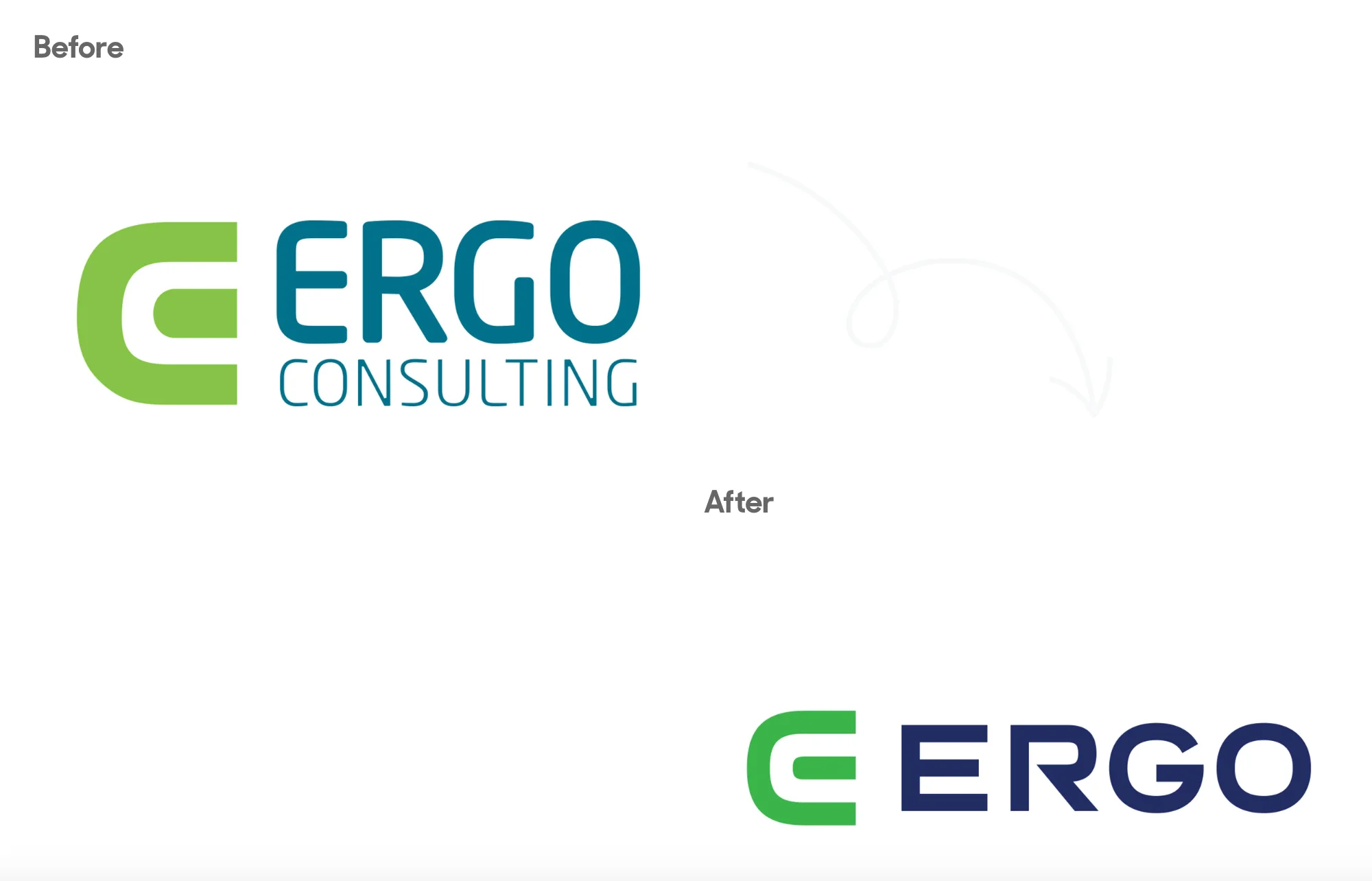
A great example is our Ergo Consulting logo refresh — a nod to their original design, refined with cleaner lines, modern typography, and a brighter green to reflect energy and growth. It proves that evolution doesn’t always mean change — sometimes, it’s about sharpening what already works.
The future of logo design: motion, AI, and dynamic branding
Logos are no longer static; they’re alive. In the next era, expect branding that moves, shifts, and adapts to context. Motion graphics already make brands feel dynamic, while AI tools are changing how designers brainstorm and prototype ideas.
Still, the future won’t replace creativity — it’ll enhance it. Just because a computer can generate a logo doesn’t mean it can capture emotion or tell a brand’s story. That’s where expert agencies like White Rabbit hop in — blending technology with artistry to craft timeless design.
How artificial intelligence is changing the art of logo design
AI can help designers explore dozens of creative directions in seconds. It’s like having an intern that never sleeps — but still needs supervision. The human touch ensures a logo isn’t just visually pleasing but strategically sound and emotionally resonant.
Our designers use modern tools to accelerate ideas, but our creative instincts guide the final outcome. Because at the end of the day, it’s not about pixels — it’s about perception.
Responsive and variable logos for a personalized brand experience
Today’s leading brands — from Google to MTV — use responsive and variable logos that adjust to context. These “living” logos adapt in color, size, and shape without losing identity.
The takeaway for small businesses? Flexibility equals longevity. As platforms evolve, so must your visuals. White Rabbit builds these adaptable identities so brands can thrive no matter how fast the digital warren changes.

How White Rabbit helps businesses hop ahead with better branding
At White Rabbit, we do more than design — we strategize. As a full-service agency in LA, we handle everything from website design and logo design to print and digital assets. Our process keeps things seamless, with one point of contact and zero chaos.
We blend creativity with communication, ensuring every design decision aligns with your brand’s story. From the first sketch to the final handoff, you’re part of the process — no guesswork, no gimmicks, no hopping in circles.
Ready to evolve your brand’s visuals? Contact us and let’s start building a logo that makes your business stand out from the burrow.
